
 chibiham
Problem-solving isn't about jumping straight to solutions. The essence lies in identifying the right problem to solve, breaking it down structurally, and running hypothesis-verification cycles.
The Nature of Problems and Issues
What Is a Problem?
A problem is the gap between the "current state (As Is)" and the "desired state (To Be)."
This simple definition matters because discussing a problem always requires "assumptions." When assumptions differ, the same situation can be framed as entirely different problems.
Examples:
- Assumption A: "Revenue should keep growing" → Flat revenue is a problem
- Assumption B: "Profit margins should be maintained" → Flat revenue may not be a problem
Defining Assumptions
Before defining a problem, you need to clarify "what cannot be changed." If you proceed with vague assumptions, you may discover mid-way that "this was never changeable," causing costly rework.
Making Assumptions Explicit
- Surface assumptions - Verbalize implicit assumptions. List things you take for granted
- Verify changeability - Is it truly unchangeable, or just a decision not to change it?
Organizing the Current State
Even with the same situation, the issue definition changes entirely depending on what you treat as constraints.
For example, given "the team is working excessive overtime":
- If "we can't hire more people" is a constraint → Issue: Improve operational efficiency
- If "workload can't be reduced" is a constraint → Issue: Increase headcount
- If "deadlines can't be changed" is a constraint → Issue: Reduce scope
The key insight: statements like "we can't hire more people" are often not true constraints (physically or legally impossible) but assumptions (decisions not to change). Questioning these assumptions can reveal better solutions. However, changing assumptions typically requires negotiation with higher-level decision-makers or stakeholders.
The Difference Between Assumptions and Constraints
| Constraint | Assumption | |
|---|---|---|
| Definition | Physically or legally unchangeable | Changeable but decided not to change |
| Examples | Laws, physics, contracts | Budget, scope, policies, deadlines |
| Approach | Accept | Room to question |
Confusing assumptions with constraints means overlooking options that could actually be changed. Asking "Is this truly unchangeable?" is the first step toward identifying the real issue.
The Difference Between Problem and Issue
The distinction between "problem" and "issue" fundamentally changes the quality of problem-solving.
| Problem | Issue | |
|---|---|---|
| Focus | An undesirable state or gap | A point requiring decision |
| Nature | "Something is wrong" | "This hasn't been decided" |
| Action | Needs to be solved | Needs a decision |
An issue is "an essential question worth answering." The key to problem-solving is extracting specific issues from vague problems.
The Problem-Solving Process
Overview
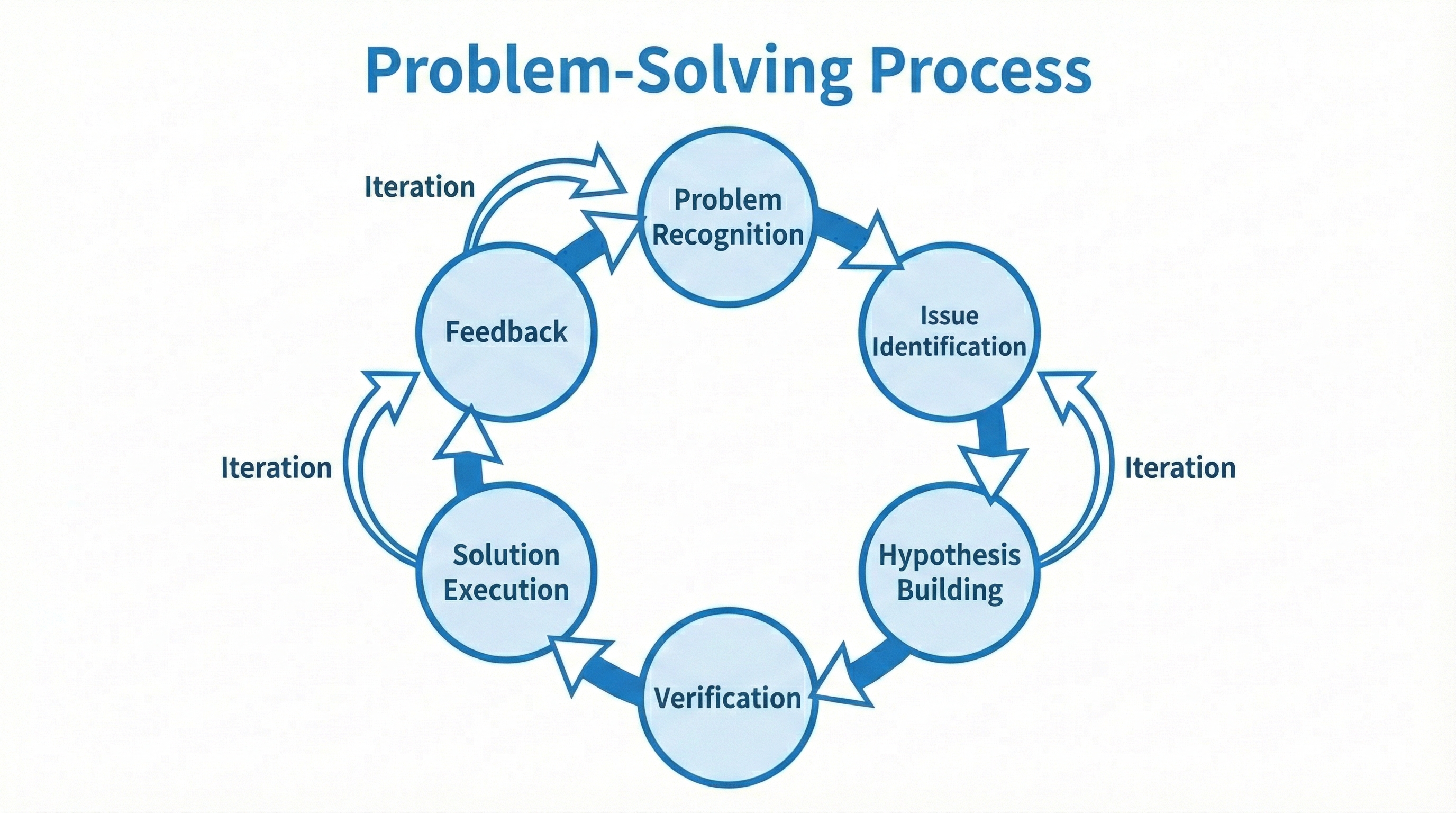 From problem recognition to feedback, each step is iteratively refined
This process is not linear — it has feedback loops. Verification results lead to hypothesis revision, and sometimes to reconsidering the problem definition itself.
The Issue-Driven Approach
Issue-driven means identifying "what to solve" first.
Even with 100 problems, only 2-3 truly need answers. Spending time on the other 97-98 is the dog's path — it won't produce high-value work.
Criteria for a good issue:
- It represents a fundamental choice - The answer significantly changes implications
- It contains a deep hypothesis - Overturns conventional wisdom or explains with new structure
- It can be answered - Verifiable with available techniques and methods
The Structure of Logical Thinking
Logical thinking is essential for problem-solving. But what does "logical" actually mean?
What Isn't Logical Thinking
The following may seem reasonable but aren't logical:
- "Young users say..."
- "Revenue growth is slowing..."
- "Industry experts say..."
- "Past best practices show..."
- "Recent competitor moves indicate..."
These are merely listing information without making relevance and importance clear. Listing facts and data is different from thinking logically.
What It Means to Be Logical
Being logical means "arguments are properly connected both vertically and horizontally."
| Direction | Meaning | Check |
|---|---|---|
| Vertical logic | Causal relationships are organized | "Is that really true?" (Any logical jumps?) |
| Horizontal logic | Complete coverage without gaps or overlaps | "Is that really all?" (Anything missing?) |
When both vertical and horizontal logic are satisfied, people can understand without confusion or discomfort.
Vertical Logic
There are two methods for constructing vertical logic: induction and deduction.
| Method | Definition | Characteristic |
|---|---|---|
| Induction | Drawing common patterns from specific examples | Discovering patterns from multiple cases |
| Deduction | Building necessary conclusions from premises | If premises are correct, conclusions are correct |
Example: A Child Asking Parents for New Shoes
Induction:
- Friend A got new shoes
- Friend B also got new shoes
- Friend C also got new shoes
- → So please buy me new shoes too
Deduction:
- I want to win the race
- My current shoes are hard to run in
- I need new shoes to win
- → So please buy me new shoes
Both reach the conclusion "buy me new shoes," but the persuasion structure differs. Induction relies on accumulated facts ("everyone has them"), while deduction relies on logical chain ("needed for the goal").
Why So? and So What?
Two questions verify vertical logic.
| Question | Direction | Meaning |
|---|---|---|
| Why So? | Top → Bottom | "Why can you say that?" Supporting message with evidence |
| So What? | Bottom → Top | "So what?" Extracting meaning from information |
Business example:
Claim: "We should prioritize Company B in Vietnam as our outsourced manufacturing partner and market entry candidate"
- Why So? → B's production costs are the lowest
- Why So? → Outsourcing risk is sufficiently low outside China
- Why So? → Vietnam's market attractiveness is the highest
The foundation of vertical logic is supporting messages with evidence using either induction or deduction.
Horizontal Logic
Large problems can't be solved as-is. You need techniques to decompose them to manageable sizes. Horizontal logic is built with MECE and Grouping.
MECE (Mutually Exclusive, Collectively Exhaustive)
The principle of decomposing with "no gaps, no overlaps." By breaking down considerations without gaps or overlaps, you ensure horizontal logic.
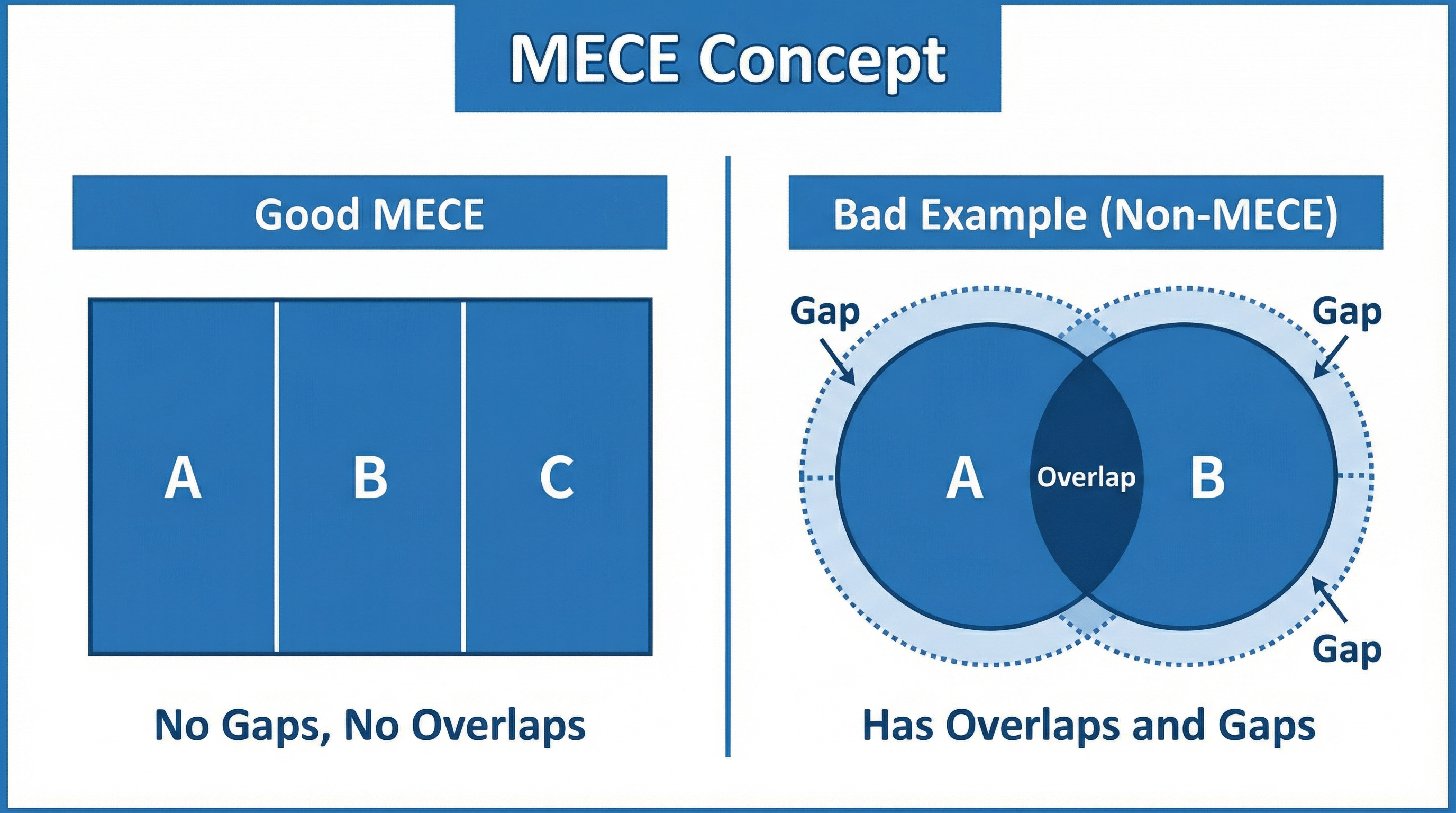 Left: Good MECE (no overlaps, no gaps), Right: Bad (has overlaps and gaps)
Four Ways to Create MECE Decomposition
| Method | Description | Example |
|---|---|---|
| Binary split (A−Not A) | Divide by opposing concepts | Domestic/International, New/Existing |
| Process split | Divide by time/procedure flow | Visit → Negotiate → Quote → Contract |
| Formula split | Divide by formula components | Revenue = Market Size × Market Share |
| Framework split | Use existing frameworks | PEST, 3C, 4P, etc. |
Formula split examples:
| Decomposition |
|---|
| Revenue = Number of employees × Revenue per employee |
| Revenue = Market size × Market share |
| Revenue = Division A + Division B + Division C |
Grouping
Grouping elements in meaningful order ensures horizontal logic.
Three Bases for Grouping
| Grouping Method | Description | Ordering |
|---|---|---|
| Causes of effects | Group by causes that lead to outcomes | Chronological order (process sequence) |
| Parts of a whole | Group by components of a whole | Structural order (upstream → downstream) |
| Similar items | Group by meaning, shape, or properties | Order by degree (importance, scale, etc.) |
Logic Trees
A technique for decomposing problems into tree structures. Multiple types exist based on decomposition perspective.
- Where type (Where is the problem?) - Identify problem location by product, region, etc.
- What type (What is the problem?) - Decompose and identify problem elements
- Why type (Why is the problem occurring?) - Dig into causal relationships for root causes
- How type (How to solve it?) - Structure solution options
Perspectives for Decomposition
The same problem reveals different insights depending on the lens. Trying multiple perspectives helps reach the problem's essence.
| Perspective | Example |
|---|---|
| Process | Procurement → Manufacturing → Sales → After-service |
| Customer segment | B2B/B2C, by industry, by size |
| Time horizon | Past → Present → Future |
| Geography | By region, by country |
| Product/Service | By category, by SKU |
| 4P/4C | Product, Price, Place, Promotion |
Pyramid Structure
Logical thinking and explanation can be expressed as a "pyramid structure." Both vertical and horizontal logic must be sound.
| Direction | Components | Role |
|---|---|---|
| Vertical logic | Why So? / So What? | Support messages with evidence / Extract meaning from information |
| Horizontal logic | MECE / Grouping | Decompose without gaps or overlaps / Arrange in meaningful order |
Navigating Between Concrete and Abstract
In problem-solving, you need to consciously switch the granularity of observation.
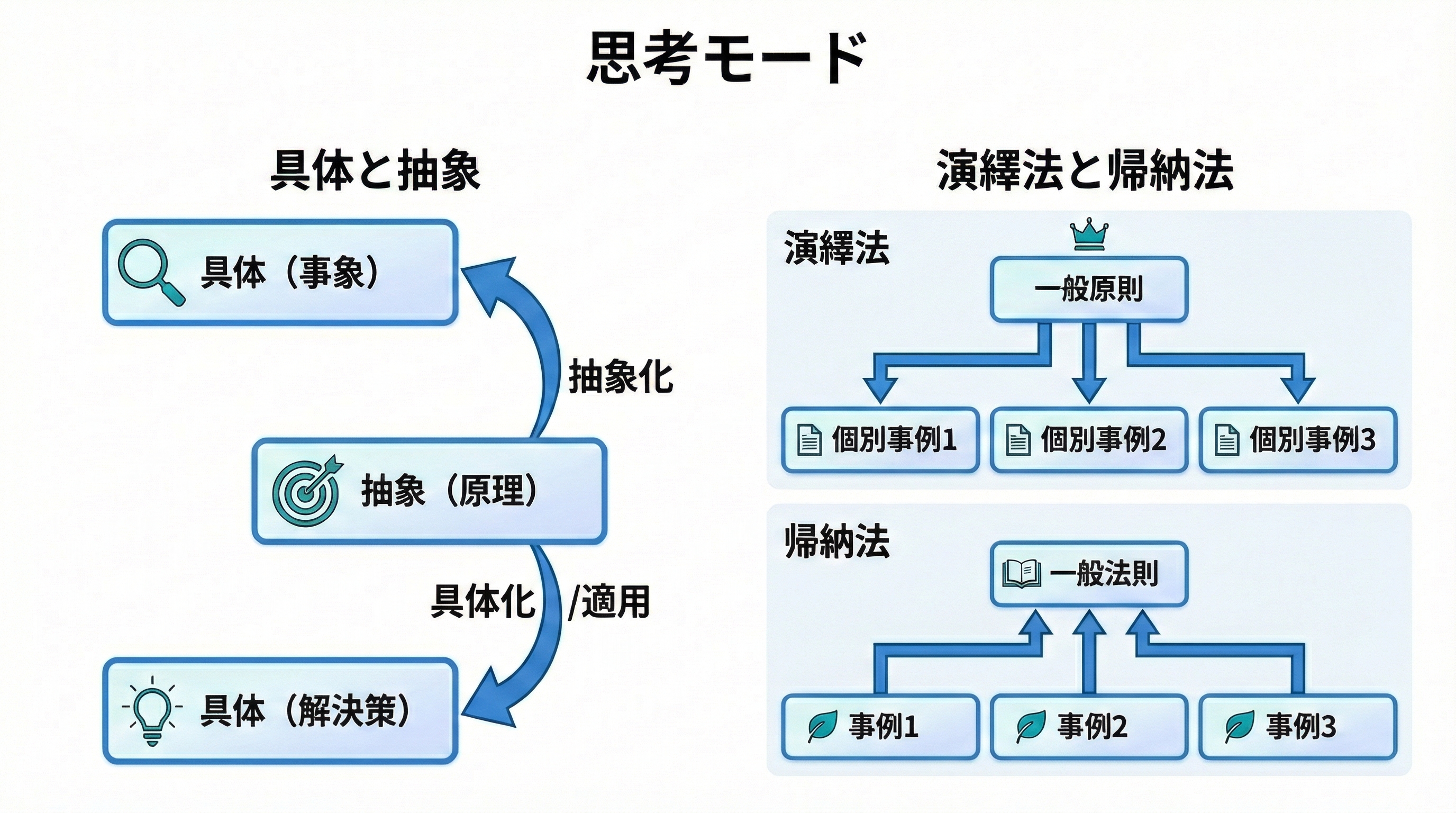 Moving between concrete and abstract (phenomena → principles → solutions)
Concrete ⇔ Abstract as Observation Granularity
| Thinking Direction | Characteristic | When to Use |
|---|---|---|
| Concretization | Drill into details, cite examples | Verification phase, execution planning |
| Abstraction | Extract essence, find commonalities | Problem structuring, pattern recognition |
Problem-solving involves moving between concrete and abstract. You find abstract structures in concrete phenomena, then apply those structures to different concrete situations.
The Hypothesis Generation Process
From observing "the system got slow," you form the hypothesis "maybe database queries are the cause." This hypothesis generation is often called abduction (hypothetical reasoning), frequently introduced as a "third form of reasoning" alongside deduction and induction.
However, treating abduction as equal to deduction and induction is problematic.
The formal structure of abduction:
If H, then E occurs
E was observed
∴ H is true
In logic, this is called the "fallacy of affirming the consequent" — it's not a valid inference.
The actual hypothesis generation process:
Observing how hypotheses actually emerge reveals multiple combined elements:
- Inductive element - "A similar delay happened before, and it was caused by the DB" — pattern recognition from past cases
- Deductive element - "Heavy queries slow down responses" — applying known principles
- Question framing - "What could be the explanatory variable?" — choosing a perspective
In other words, hypothesis generation is a composite process of induction, deduction, and question framing. The term "abduction" is a name given to the result of this composite process (the emergence of a hypothesis).
What matters in hypothesis-driven thinking is consciously running this composite process. And every generated hypothesis must be verified.
Thinking Modes by Phase
| Phase | Primary Thinking |
|---|---|
| Problem recognition | Abstraction, questioning assumptions |
| Issue identification | Concretization, questioning assumptions |
| Issue decomposition | Abstraction, deduction (applying MECE) |
| Hypothesis building | Induction (pattern recognition), deduction (applying principles), question framing |
| Verification | Deduction, concretization |
| Feedback | Induction, questioning assumptions |
Questioning Assumptions
In problem-solving, induction and deduction are reasoning forms that constitute "vertical logic." Meanwhile, "questioning assumptions" operates on a different dimension from reasoning forms.
What Is Metacognition?
Metacognition is objectively observing your own thinking. It asks "Why do I see this as a problem?"
| Level | Content |
|---|---|
| Normal cognition | Let me solve this problem |
| Metacognition | Why do I see this as a problem? Are my assumptions correct? |
Four Situations for Questioning Assumptions
There are four situations where metacognition becomes particularly important.
1. Problem Definition: Making Assumptions Explicit
When defining problems, verbalize implicit assumptions. Proceeding with vague assumptions leads to rework.
- Surface "what cannot be changed"
- Distinguish "what could be changed but was decided not to"
2. Hypothesis Generation: Framing Questions
When generating hypotheses, set the question "what should we consider as explanatory variables?" This question framing itself is metacognition.
- "What factors could explain this phenomenon?"
- "What caused similar cases in the past?"
- "What analytical lens would be most effective?"
3. Refining Assumptions Through Analysis
As analysis progresses, assumption resolution can improve. Initially vague assumptions become more precise through exposure to concrete data and examples.
Assumption refinement patterns:
| Pattern | Example |
|---|---|
| Narrowing scope | "Customers are price-sensitive" → "New customers are price-sensitive, but existing customers prioritize service quality" |
| Refining definitions | "Productivity is low" → "Routine task processing speed is fine, but non-routine task initiation is slow" |
| Discovering conditions | "This system is slow" → "It becomes dramatically slower when data volume exceeds a threshold" |
Through this feedback loop, the initially set issue often changes. In fact, when the issue definition remains unchanged throughout analysis, that itself may be a sign to question assumptions.
4. When Stuck: Discovering the Real Issue
When problem-solving reaches a dead end, questioning assumptions themselves can reveal breakthroughs.
- "Is this problem definition correct in the first place?"
- "What if we placed different assumptions?"
- "Is what we thought was a constraint truly unchangeable?"
Single-Loop and Double-Loop
The concept of double-loop learning is crucial for understanding assumption-questioning thinking.
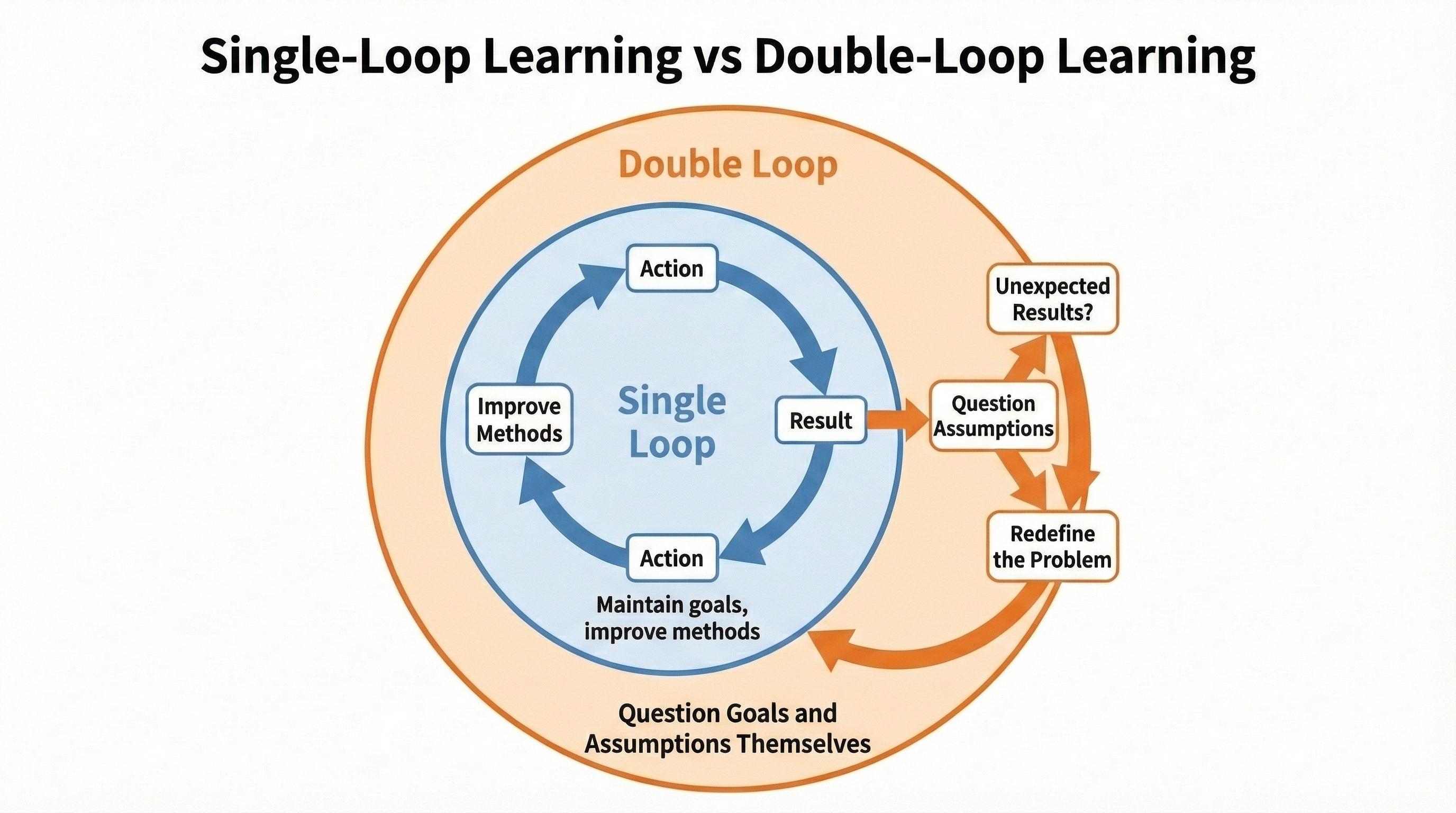 Blue inner loop: Single-loop staying within method improvement. Orange outer loop: Double-loop questioning assumptions themselves
| Loop | Focus | Question |
|---|---|---|
| Single-loop | Improving methods | "How do we achieve the goal?" |
| Double-loop | Revisiting assumptions | "Is the goal correct? Are assumptions valid?" |
Being trapped in surface-level problems means being confined to the single loop. Transitioning to the double loop through metacognition enables reaching the real issue.
Identifying the Real Issue
From Surface Problems to Deeper Layers
Initially recognized problems are often "superficial."
For example, with the surface problem "the team's productivity is low," repeatedly asking "why?" leads to "members lack skills" → "hiring criteria are vague and there's no evaluation or feedback system" — the real issue.
Solutions for surface problems (more training) are merely symptomatic treatment. Without addressing the real issue (hiring and evaluation systems), problems will recur.
Extracting Issues from Analysis
Identifying the real issue means extracting "issues that effectively approach the problem" from analysis results built with vertical and horizontal logic.
Horizontal Logic: Understanding Problem Structure
Decompose problems with MECE and identify where issues lie.
| Decomposition Lens | Question |
|---|---|
| Process | At which stage does the problem occur? |
| Resources | Where are constraints among people, things, money, time? |
| Components | Which part or function has the problem? |
Vertical Logic: Pursuing Causal Relationships
Use Why So? to dig into causality and identify fundamental explanatory variables.
| Deep-dive Perspective | Question |
|---|---|
| Skills | What's the gap between required and current capabilities? |
| Systems | Are there problems with rules, policies, or systems? |
| Incentives | Does the structure encourage desired behavior? |
Evaluating Issue Candidates
Derive issue candidates from identified explanatory variables, extracting implications with So What?
| Evaluation Axis | Question |
|---|---|
| Impact | How much would solving this issue resolve the problem? |
| Sustainability | Temporary improvement or permanent solution? |
| Feasibility | Executable under current assumptions and constraints? |
| Side effects | Would the solution create new problems? |
Issue Levels
Issues range from "symptomatic treatment" to "structural reform." You need to determine the right level of intervention.
| Level | Target | Example | Sustainability |
|---|---|---|---|
| Symptomatic treatment | Symptoms | Manually fix errors when they occur | Low (recurs) |
| Operational improvement | Work methods | Introduce checklists | Medium (people-dependent) |
| System improvement | Rules/policies | Change approval flows | High (guaranteed by system) |
| Structural reform | Organization/systems | Department reorganization, system overhaul | Highest (root resolution) |
Decision Criteria for Level Selection
- Same problem keeps recurring → Consider higher-level intervention
- Spans multiple departments/processes → System improvement or structural reform
- Incentive structure is the problem → Structural reform may be needed
- Resource constraints are tight → Start with a feasible level
Structural reform is highly effective but costly and risky. For "maximum impact with minimum intervention," first consider whether system improvement can address it, then choose structural reform only if insufficient.
Questioning Techniques
To reach the real issue, practice metacognition. Specific questioning techniques:
- Question assumptions: "Is this really a problem?"
- Change perspective: "How would it look from a different position?"
- Change time horizon: "Will this still be a problem in 1 year? 5 years?"
- Change scale: "Is this a partial problem or a systemic one?"
Through these questions, transition from single-loop (improving methods) to double-loop (revisiting assumptions) to reach the real issue.
Identifying "Problems Not Worth Solving"
Not every problem needs solving. Use these questions to determine if it's worth pursuing:
- Does it need an answer now? (Timing)
- If answered, would it change actions? (Actionable)
- Is it our problem to solve? (Ownership)
- Do we have resources to solve it? (Feasibility)
Communicating with Persuasion
Solving the problem alone isn't enough. Communicating analysis results, gaining understanding, and driving action are all part of the problem-solving process.
Why "Communication" Is Part of Problem-Solving
No matter how excellent the analysis, if it doesn't reach decision-makers and executors, the problem remains unsolved. "Communication" isn't the final step — it's part of the solution.
Communication serves three purposes:
| Purpose | Content |
|---|---|
| Shared recognition | Make others recognize the problem's existence and nature |
| Gaining buy-in | Convince why this issue should be addressed and why this solution |
| Driving action | Motivate specific actions |
Only when all three are achieved does problem-solving complete.
Start with Shared Assumptions
The first thing to do in an explanation isn't presenting analysis results or proposals. It's sharing the recognition of "what the problem is" with your audience.
Sharing As-Is / To-Be
A problem is "the gap between the current state (As Is) and the desired state (To Be)." If this gap perception isn't aligned with your audience, even the most logical explanation will miss the mark.
Three elements to share:
- As-Is recognition - Is the factual understanding of "what's happening now" aligned?
- To-Be recognition - Is the goal understanding of "how things should be" aligned?
- Gap magnitude - Is this gap a problem requiring action, or within acceptable range?
The "desired state" especially varies by position and values. What's an obvious problem for you may not be a problem at all for others. Align here first.
Understanding Your Audience's Context
Build explanations based on your audience's prior knowledge, interests, and constraints.
| Item to Understand | Question |
|---|---|
| Knowledge level | Will technical terms be understood? Do they have background knowledge? |
| Interests | What are they concerned about? What do they want to know? |
| Position/Constraints | What constraints affect their decision-making? |
| History | What recognition do they already have about this problem? |
Explanations that ignore audience context won't resonate, no matter how logical. "Being correct" and "being understood" are different.
Share Important Assumptions Before Details
Before presenting analysis results or proposals, share the prerequisite knowledge needed for understanding. Starting with unfamiliar concepts or terminology creates a "I don't understand what you're saying" state before content is even considered.
Tips for sharing assumptions:
- When using technical terms, explicitly define them first
- Explain the analytical framework (MECE decomposition, logic tree structure) first
- Include the rationale for why you chose that analytical lens
Communicate Analysis Results Structurally
Analysis built with vertical and horizontal logic should be communicated using that structure.
Horizontal Logic: Show How You Decomposed
Present the MECE decomposition structure and clearly show "where in the whole the problem lies."
What matters is communicating not just results, but "what lens you used for decomposition" and "why you chose that lens." This demonstrates the analysis's comprehensiveness and validity.
| Element to Communicate | Content |
|---|---|
| Decomposition lens | What axes were used to break down the problem |
| Lens selection rationale | Why that lens is appropriate |
| Problem location | Where the problem was identified as a result of decomposition |
Vertical Logic: Show Why You Can Say That
Present causal relationships explored through Why So? and clearly show "why you reached that conclusion." Showing the chain of causality lets your audience verify that "there are no logical jumps."
Show the Basis for Issue Extraction
Make explicit the So What? (what can we conclude?) when extracting issues from analysis. After presenting issue candidates, also explain the evaluation criteria (impact, feasibility, sustainability) for why you selected that particular issue.
Building a Storyline
The overall flow for communicating analysis results is the storyline. Use representative composition patterns.
Sky, Rain, Umbrella
Composed as facts → interpretation → action. Connect from problem recognition to action proposal with consistent logic.
Sky (Facts): Three major clients in western Japan switched to competitor B
    ↓
Rain (Interpretation): Declining price competitiveness is the cause.
                        If left unchecked, it will spread to other regions
    ↓
Umbrella (Action): Review cost structure and implement price revision within 3 months
When this structure breaks down, persuasiveness is lost:
| Breakdown | Problem |
|---|---|
| Rain without sky | Interpretation without factual backing (assumption) |
| Umbrella without rain | Action proposal skipping interpretation (abrupt) |
| Rain without umbrella | Interpretation only without action proposal (so what?) |
Parallel Why's
A composition supporting conclusions with multiple reasons. Leverages the horizontal logic of pyramid structure.
Claim: Prioritize cost structure review

Because:
├── 1. Price gap is the main driver of competitor switching (high impact)
├── 2. Manufacturing process review projects 15% cost reduction (feasible)
└── 3. Takes effect faster than other measures (immediacy)
Balancing Logic and Emotion
Persuasion requires not just logic but also emotional appeal.
| Element | Role | Method |
|---|---|---|
| Logos (Logic) | Convince | Data, causal relationships, structured explanation |
| Pathos (Emotion) | Create empathy | Specific episodes, sense of urgency, future vision |
| Ethos (Trust) | Build credibility | Track record, expertise, sincere attitude |
Logic alone won't move people. Emotion alone won't sustain. Without trust, they won't listen at all. Be conscious of balancing all three.
Examples of emotional appeal:
- Instead of abstract numbers alone, share specific customer voices
- Present a crisis scenario of "what happens if we do nothing"
- Paint a vision of "what things look like after solving this"
Communication Checklist
| Aspect | Check Item |
|---|---|
| Shared assumptions | Is the As-Is / To-Be recognition aligned with your audience? |
| Shared assumptions | Have you understood your audience's context (knowledge, interests, constraints)? |
| Shared assumptions | Have you shared prerequisite knowledge before specific explanations? |
| Structure | Have you explained the decomposition lens and its rationale? |
| Structure | Are there no logical jumps in each step of causality? |
| Structure | Have you answered So What? (what can be concluded)? |
| Action | Is it clear what specifically should be done? |
| Action | Have you proactively addressed anticipated objections? |
| Expression | Is it one message per chart? |
| Expression | Does it appeal to emotion, not just logic? |
Summary: The Problem-Solving Mindset
- Don't jump to solutions - Don't latch onto surface problems; identify the real issue
- Start from the issue - Decide what to solve first. Avoid the dog's path
- Think logically - Satisfy both vertical logic (causality) and horizontal logic (comprehensiveness). Organize thinking with pyramid structure
- Navigate between concrete and abstract - Find structures in phenomena, apply structures to different situations
- Question assumptions - Exercise metacognition during problem definition, hypothesis generation, and when stuck
- Decompose to manageable size - Ensure horizontal logic with MECE/Grouping, vertical logic with Why So?/So What?
- Run hypothesis-verification cycles - Analysis without hypotheses is mere busywork
- Communication completes problem-solving - Storyline, balance of logic and emotion
Problem-solving is a skill that improves with deliberate practice. Start by "identifying" before "solving."